
| Corresponding Author | 李偉鵬 | Title | Eco-Friendly Magnetic Poly(3,3′-diaminobenzidine)-Coated Nanocomposites Enabling Selective Gold Recovery and Post-Adsorption Heterogeneous Catalysis Application |
| Authors | Zong-You Huang, Wen-Jyun Wang, Ming-Shun Hsieh, Hidenobu Takahashi, Wei-Peng Li* | Publication Date | 2026.2.1 |
| Citation | 10, e01984 | Journal | Small Methods |
| Impact Factor (2026) | 8 | DOI | 10.1002/smtd.202501984 |
| WOS/PMID | WOS:001649817700001 |
Eco-Friendly Magnetic Poly(3,3’-diaminobenzidine)-Coated Nanocomposites Enabling Selective Gold Recovery and Post-Adsorption Heterogeneous Catalysis Application
Zong-You Huang, Wen-Jyun Wang, Ming-Shun Hsieh, Hidenobu Takahashi, Wei-Peng Li*
Small Methods, 2026, 10, e01984. (IF-8.0)
https://doi.org/10.1002/smtd.202501984
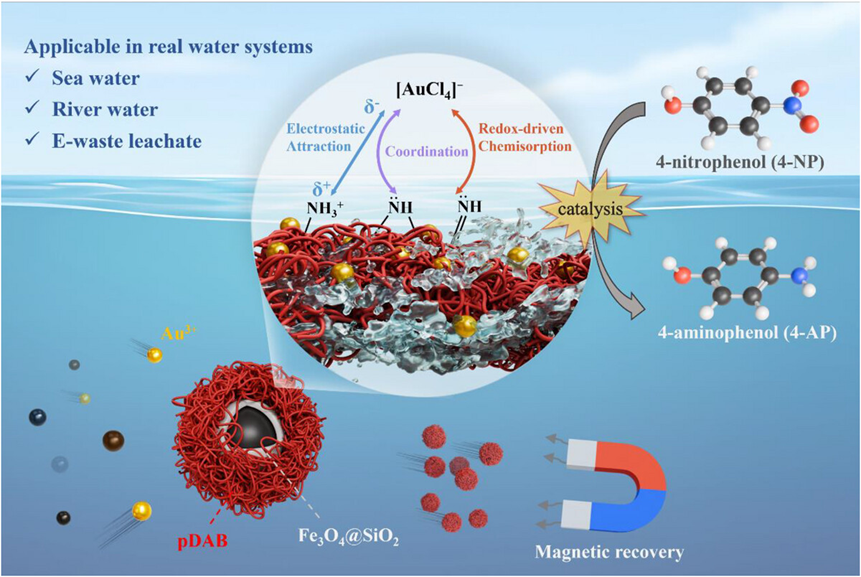
To date, the rising demand for precious gold in advanced electronics and energy technologies depends on the continuous mining of limited natural gold resources. Therefore, developing a sustainable method for selectively recovering gold from industrial waste is both necessary and challenging. Here, we present a practical strategy that utilizes a magnetic nanocomposite to enable the specific capture of gold and subsequent heterogeneous catalysis by the collected Au. Superparamagnetic ferrosoferric oxide nanoparticles (Fe3O4 NPs) are prepared as the starting material via thermal decomposition. These Fe3O4 NPs are then coated with a silica (SiO2) shell via a sol-gel reaction to form the core–shell Fe3O4@SiO2 nanocomposite. The surface of Fe3O4@SiO2 is subsequently encapsulated with poly(3,3′-diaminobenzidine) through H2O2-initiated polymerization of 3,3′-diaminobenzidine monomer (DAB), creating the Fe3O4@SiO2@pDAB magnetic nanobeads. The resulting nanobeads demonstrated an outstanding Au(III) ion adsorption capacity of 458.23 mg/g, as fitted by the Langmuir model. Its selective adsorption process follows pseudo-second-order kinetics, indicating pDAB-Au chemisorption as the primary mechanism. Additionally, the nanobeads enabled >99% magnetic recovery of trace Au3+ ions, and the Au-loaded materials acted as effective catalysts for 4-nitrophenol reduction with a rate constant of 0.0107 s−1, demonstrating dual functionality in both gold recovery and environmentally friendly catalysis.