| Corresponding Author | 許智能 | Title | Unexpected Tricopper(II) Clusters Formation in Tripodal Ligand Framework and Their Application on Click Reaction |
| Authors | Chu, Y.-T.; Chang, C.-J.; Chang, Y.-L.; Chen, H. Y.; Ding, S.; Wang, V. C.-C.; Hsu, S. C. N.* | Publication Date | 2026.2.26 |
| Citation | 40(2), e70512 | Journal | Applied Organometallic Chemistry |
| Impact Factor (2026) | 4.3 | DOI | 10.1002/aoc.70512 |
| WOS/PMID | WOS:001674878900002 |
Unexpected Tricopper(II) Clusters Formation in Tripodal Ligand Framework and Their Application on Click Reaction
Chu, Y.-T.; Chang, C.-J.; Chang, Y.-L.; Chen, H. Y.; Ding, S.; Wang, V. C.-C.; Hsu, S. C. N.*
Appl. Organomet. Chem. 2026, 40, e70512 (IF-4.3)
https://doi.org/10.1002/aoc.70512
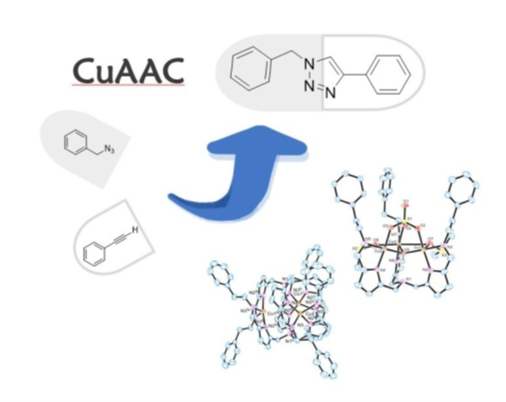
Researchers from the Sodio Lab at Kaohsiung Medical University have developed a novel tripodal ligand and unexpectedly discovered two rare tricopper(II) clusters with unique molecular architectures. These multinuclear copper complexes demonstrated excellent performance in copper-catalyzed azide-alkyne cycloaddition (CuAAC), a key “click chemistry” reaction widely used in pharmaceutical and materials research. One tricopper catalyst achieved nearly complete conversion within just five minutes, significantly outperforming conventional systems. The study provides new insights into the relationship between metal cluster structures and catalytic activity, offering promising strategies for designing highly efficient catalysts for organic synthesis, chemical manufacturing, and future biomedical applications.